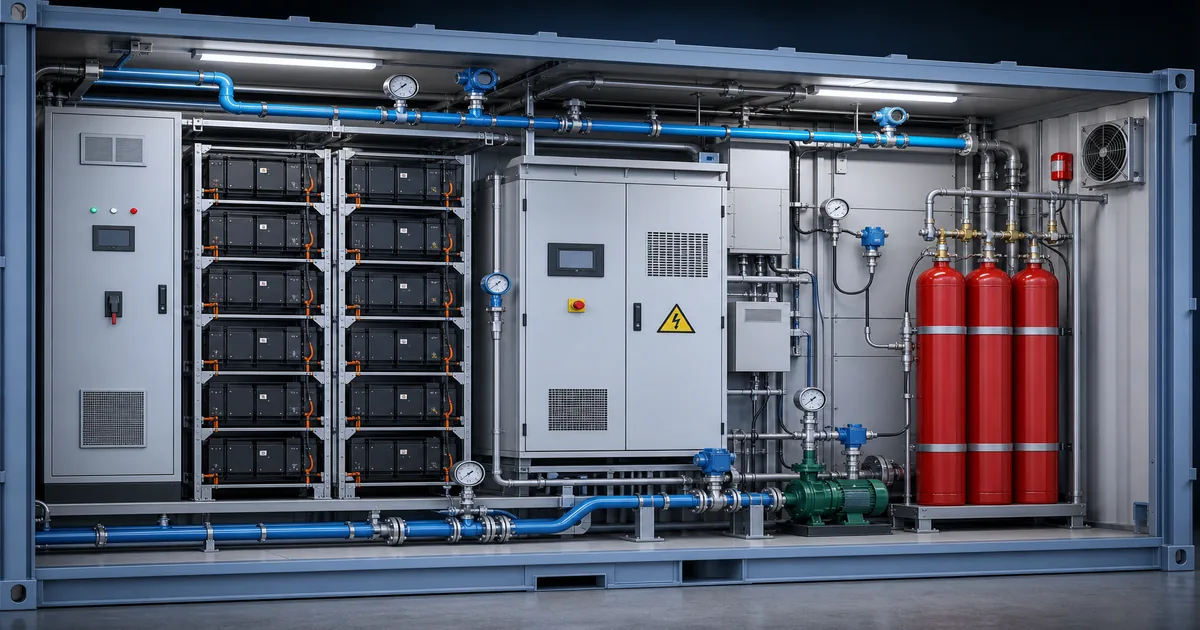
BESS fire suppression pressure monitoring is the practice of measuring cylinder pressure, agent manifold pressure, water or water-mist supply pressure, coolant-loop pressure and enclosure ventilation signals around a battery energy storage system. The goal is not to predict thermal runaway by pressure alone. It is to make the fire-protection and auxiliary fluid systems visible enough for inspection, commissioning, maintenance and alarm logic.
Why BESS fire suppression pressure monitoring matters
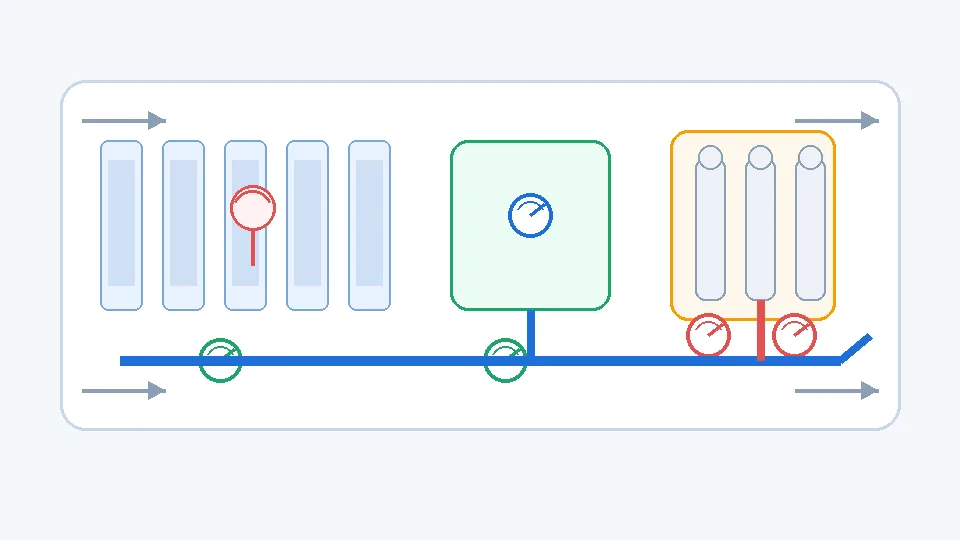
BESS fire suppression pressure monitoring matters because battery energy storage projects combine electrical hazards, thermal runaway risk, enclosed containers, ventilation paths, cooling circuits and fire-protection equipment. A local pressure gauge or pressure transmitter cannot certify that a battery rack is safe, but it can show whether the suppression cylinder bank, water-mist supply, coolant pump or manifold is in the expected condition before operators rely on it.
UL describes UL 9540A as a test method for evaluating thermal runaway fire propagation in battery energy storage systems. NFPA 855 is the installation standard many projects reference for stationary energy storage hazards and mitigation. In that context, pressure instruments are supporting evidence for readiness and maintenance, not a substitute for listed equipment, hazard mitigation analysis, gas detection, ventilation, fire detection or emergency response planning.
Browse Pressure Gauge OptionsExplore 143+ industrial gauge models→Map pressure points before selecting gauges or transmitters
Useful BESS pressure points are selected from the fire-protection drawing, cooling P&ID and container layout. Common points include clean-agent or inert-gas cylinder pressure, discharge manifold pressure, water-mist pump outlet pressure, sprinkler or deluge supply pressure, coolant-loop supply and return pressure, filter differential pressure, expansion tank pressure and any pneumatic actuation line used by valves or dampers.
| Pressure point | Why it is monitored | Typical instrument choice |
|---|---|---|
| Clean-agent or inert-gas cylinder bank | Storage readiness, leakage trend, maintenance inspection | Local gauge plus pressure switch or transmitter when remote alarm is required |
| Agent discharge manifold | Confirms discharge path and commissioning test behavior | Pressure transmitter or test gauge connection with isolation |
| Water mist or sprinkler supply | Pump output, blocked valve, low supply pressure | Liquid-filled gauge, pressure switch or transmitter |
| Coolant loop and filters | Pump condition, air pocket, filter loading, leak detection support | Paired gauges, differential pressure gauge or transmitter |
Choose BESS fire suppression pressure gauge ranges carefully
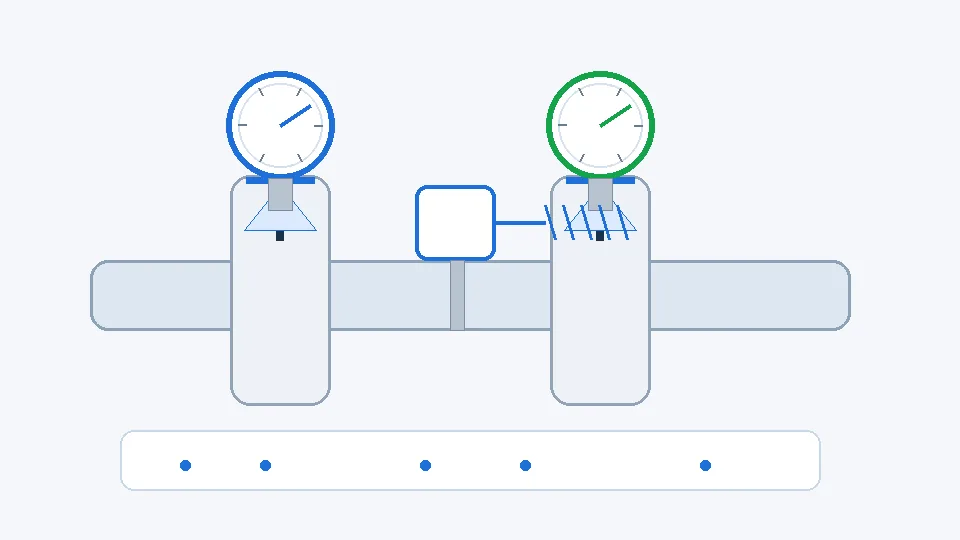
A BESS fire suppression pressure gauge should be ranged from the actual system design pressure, not from a generic catalogue habit. Cylinder service may need a high-pressure gauge matched to the stored agent or inert gas package. Water-mist and sprinkler systems may use lower ranges but require compatibility with wet service, pump vibration and test procedures. Coolant loops often need lower pressure ranges with good readability around normal pump operation.
For steady pressure points, normal pressure is commonly kept in the readable middle portion of the dial, with margin for pump start, temperature effects and test pressure. For remote alarms, a transmitter or pressure switch should match the alarm threshold, accuracy requirement, output signal and site control system. Avoid using one instrument range for every point in the container; cylinder banks, manifolds and coolant loops behave differently.
Request a Pressure Instrument ChecklistOur engineers respond within 24 hours→Materials, connections and enclosure conditions
Material compatibility depends on the medium. Stainless steel wetted parts are often preferred for outdoor containers, humid coastal sites, glycol-water coolant, washdown and long maintenance intervals. Brass or copper-alloy parts may be acceptable in some water or air services but should be checked against the project specification. Oxygen-enriched, inert-gas, clean-agent and corrosive coolant services require the supplier and system integrator to confirm seals, fill fluids, cleaning requirements and thread forms.
Common connections include NPT, BSP, G and metric threads, plus test couplings and manifold ports. Do not force unlike thread forms. Use isolation valves where a gauge must be removed during maintenance, but make sure valve position is controlled so the instrument is not accidentally isolated when operators depend on it. For vibration from pumps, fans or container transport, consider liquid-filled gauges, support brackets, remote mounting or transmitters designed for the environment.
Pressure monitoring cannot replace BESS safety design
Pressure monitoring has clear limits. A normal cylinder pressure reading does not prove that no battery module is overheating. A normal coolant pressure does not prove correct flow through every rack. A manifold pressure event during a discharge test does not prove agent concentration in every enclosure volume. Pressure signals must be interpreted together with BMS data, smoke or gas detection, temperature sensing, ventilation status, fire alarm logic and the approved commissioning record.
For containerized lithium-ion BESS, thermal runaway, off-gas behavior and explosion control must be handled by qualified fire-protection and electrical engineers. Treat this article as an instrument selection reference only. Project-specific acceptance should follow UL 9540A test data, NFPA 855 or local code requirements, the system integrator's design, the authority having jurisdiction and the battery manufacturer's safety documentation.
RFQ checklist for BESS pressure instruments
Before requesting BESS pressure instruments, collect the media, normal pressure, maximum allowable pressure, test pressure, temperature, location, enclosure IP requirement, vibration level, connection thread, wetted material, case material, accuracy class, dial diameter, electrical output, alarm setpoint, cable entry, hazardous-area requirement and whether the instrument is for local inspection, alarm logic or commissioning only.
Helpful internal references include pressure transmitter vs pressure gauge selection, pressure gauge snubber selection and liquid cooling pressure monitoring. In short, BESS fire suppression pressure monitoring is strongest when each pressure point is tied to a maintenance or safety decision instead of being added as a generic accessory.
Frequently asked questions
Can a pressure gauge detect BESS thermal runaway?
No. A pressure gauge can monitor suppression, coolant or pneumatic systems, but thermal runaway assessment needs BMS data, temperature, gas or smoke detection, ventilation status and approved fire-protection logic.
Where should BESS fire suppression pressure gauges be installed?
Typical points include clean-agent or inert-gas cylinder banks, agent manifolds, water-mist pump outlets, sprinkler supply lines, coolant-loop supply and return headers, filters and expansion tanks.
Should BESS use gauges or pressure transmitters?
Use local gauges for inspection and commissioning visibility. Use pressure transmitters or switches when the signal must feed alarms, SCADA, fire panels or remote maintenance records.
What materials are suitable for BESS pressure instruments?
Material choice depends on the medium. Stainless steel wetted parts are common for outdoor, humid, glycol-water or long-life service, but clean-agent, inert-gas and coolant compatibility must be confirmed by the system integrator.
Does NFPA 855 specify one pressure gauge range?
No. Range selection depends on the approved system design: cylinder storage, manifold discharge, water supply and coolant loops can all require different pressure ranges and acceptance criteria.