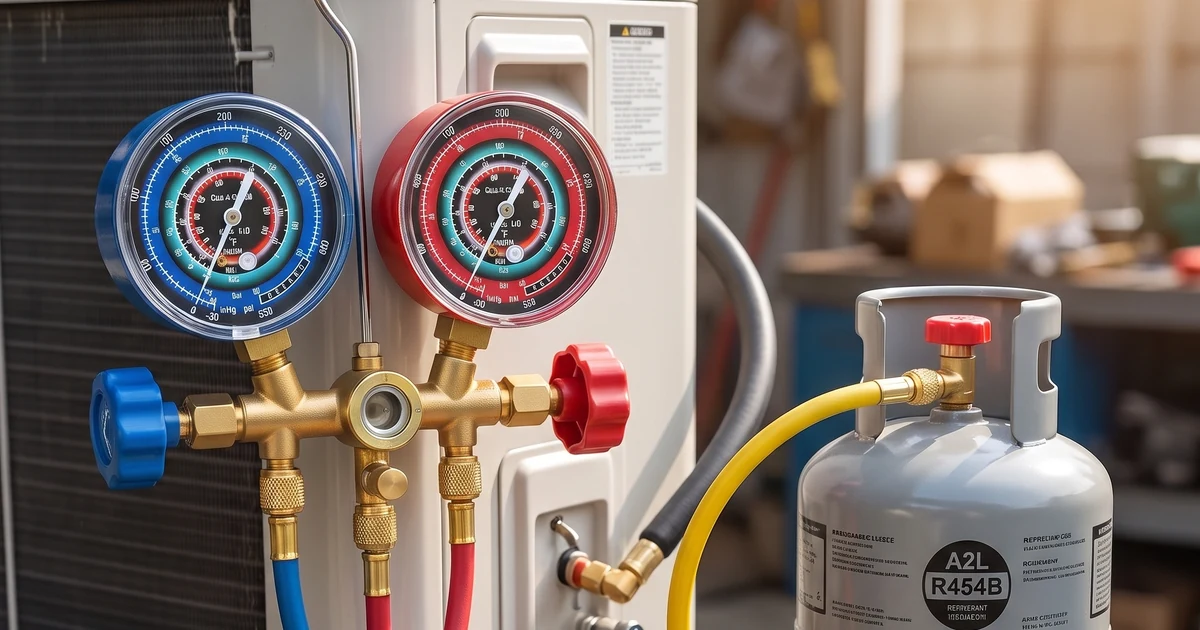
A2L R-454B refrigerant pressure gauge selection has become a practical HVAC service subject as new heat pumps and air conditioners move toward lower-GWP refrigerants such as R-454B and R-32. A refrigerant pressure gauge does not decide the charge by itself. It gives technicians a live high-side and low-side pressure reference that is checked against the equipment label, manufacturer pressure-temperature chart, measured temperatures and the approved service procedure. For distributors and service teams buying Manogauge ZX-10 refrigerant gauges, the buying decision connects pressure range, 7/16 inch UNF connection, hose set, dial readability and the A2L service workflow instead of treating the gauge as a generic industrial instrument.
Why A2L and R-454B changed HVAC service checks
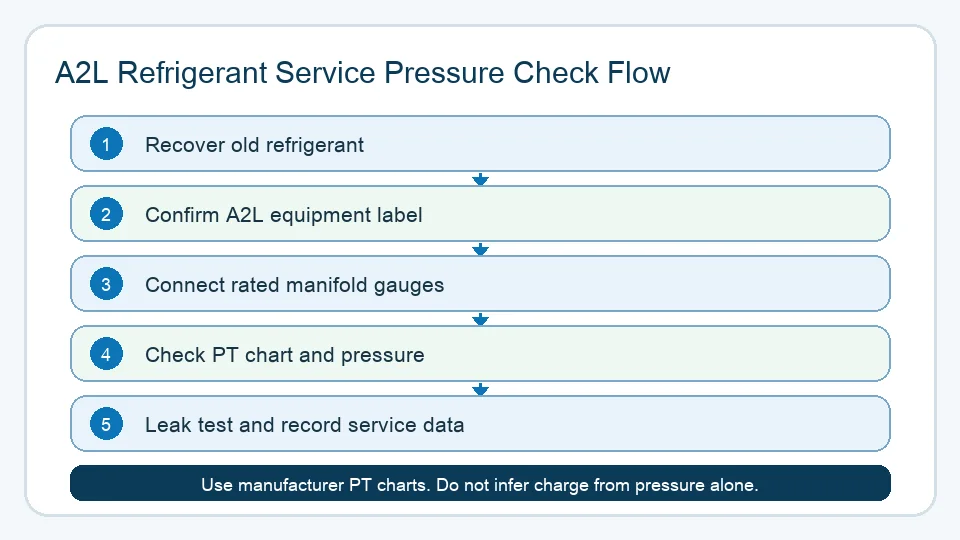
The A2L transition is now visible in HVAC service because equipment labels, refrigerant cylinders, recovery machines, leak detection practices and technician training are changing at the same time. Bosch describes the industry move toward lower-GWP refrigerants for residential heating and cooling equipment, and the EPA SNAP program lists acceptable substitutes and use conditions for residential and light commercial air conditioning and heat pumps. These changes create a real search need: service teams want to know how pressure checks fit into the new refrigerant workflow.
For Manogauge, the natural product connection is the refrigerant pressure gauge ZX-10-R used as part of a manifold set. On an A2L job, the gauge reading is one field signal, not a complete diagnosis. The technician still needs the equipment nameplate, refrigerant type, manufacturer pressure-temperature chart, measured line temperatures, leak-test result and local safety procedure. That distinction keeps A2L R-454B refrigerant pressure gauge selection accurate and useful for buyers.
Helpful background references include the Bosch A2L refrigerant change guide and the EPA SNAP page for residential and light commercial air conditioning substitutes.
View Refrigerant Pressure GaugesExplore 143+ industrial gauge models→What a refrigerant manifold gauge actually measures
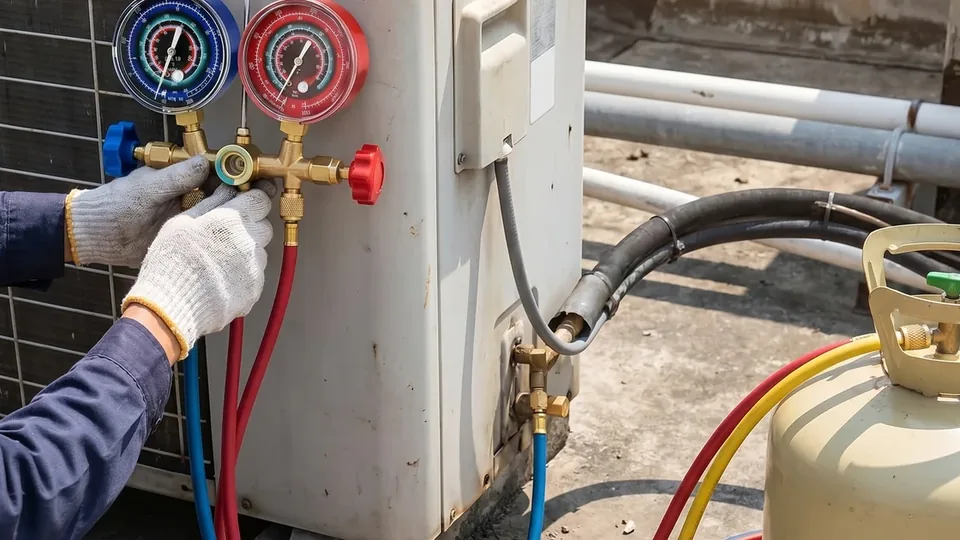
A refrigerant manifold gauge set is normally used as a paired service tool. The blue gauge reads the low-pressure side, and the red gauge reads the high-pressure side. During commissioning, recovery, evacuation checks or troubleshooting, the technician connects rated hoses to the service ports of the outdoor unit or refrigeration circuit, then compares the pressure values with the refrigerant PT chart and temperature readings.
This use environment is different from a permanent process gauge on a pump, water-treatment skid or data-center coolant pipe. A refrigerant gauge is handled, connected, disconnected and stored as part of an HVAC service kit. In real field service, the red and blue manifold gauges are positioned at an outdoor HVAC unit with hoses, service valves and a recovery or service cylinder nearby.
The same mechanical principles still matter: vibration control, overpressure protection, dial readability, connection-thread protection and sealing. For general mounting guidance, see Manogauge’s pressure gauge installation best practices.
Read the gauge against the right saturation value: bubble point, dew point and glide
R-454B is a zeotropic blend, so it does not boil and condense at a single temperature the way a single-component refrigerant does. At one pressure the blend has two saturation temperatures: the bubble point, where the last liquid starts to boil, and the dew point, where the last vapour condenses. The difference between them is the temperature glide. This is the single most common reason a correct pressure reading produces a wrong service conclusion on an A2L job.
The rule technicians need is short: superheat is calculated from the dew point, subcooling from the bubble point. Use the wrong column and the answer is shifted by the whole glide, in the direction that makes an undercharged system look acceptable.
| Service task | Where the pressure is read | Saturation value to use | Compare with | Common error |
|---|---|---|---|---|
| Evaporator superheat | Suction service port, low side | Dew point at that pressure | Measured suction line temperature | Using the bubble point, or a scale ring printed for another refrigerant |
| Condenser subcooling | Liquid line or high-side port | Bubble point at that pressure | Measured liquid line temperature | Using a mid-glide average value taken from a generic chart |
| Charge verification | Both sides, after the OEM procedure | Whichever the equipment manual specifies | Weighed charge and the nameplate value | Treating pressure alone as a charging method |
| Standing pressure or leak check | Isolated circuit at a known temperature | Saturation pressure at ambient | Ambient temperature at the same moment | Reading a pressure change caused by temperature as a leak |
Take the bubble and dew values from the refrigerant supplier's pressure-temperature data or from the equipment manufacturer's service manual for that exact refrigerant. A printed scale ring on an older manifold gauge, or a PT app set to a different refrigerant, is not a substitute. Where the glide matters to the decision - marginal superheat, a long evaporator, a low-load condition - confirm the value with the refrigerant supplier rather than assuming it is negligible.
Request ZX-10 Refrigerant Gauge QuoteOur engineers respond within 24 hours→Gauge range, connection and readability for ZX-10 buyers
For the Manogauge ZX-10 refrigerant pressure gauge family, current product data lists a 0-800 psi pressure range, 50-80 mm dial sizes, steel case options, ±1.6 / 2.5% accuracy classes and a 7/16 inch UNF connection. These are useful starting points for distributors comparing replacement gauge heads, manifold gauge sets or OEM dial options. The final order is still matched to the exact refrigerant, hose set, service-port configuration and local requirement.
For R-454B or R-32 service, readability matters because the pressure value is compared with a specific PT chart. A clear psi/bar scale, correct connection and dial layout can reduce field confusion when technicians work across refrigerants. If the order involves multiple markets, check thread and connection terminology with the pressure gauge thread connection guide before confirming drawings or labels.
Relevant Manogauge options include the ZX-10-R radial refrigerant pressure gauge and the ZX-10-A axial refrigerant pressure gauge. Buyers can use the pressure gauge RFQ form to request drawings, dial artwork, sample details and configuration confirmation.
What a 0-800 psi dial actually resolves: accuracy class in field terms
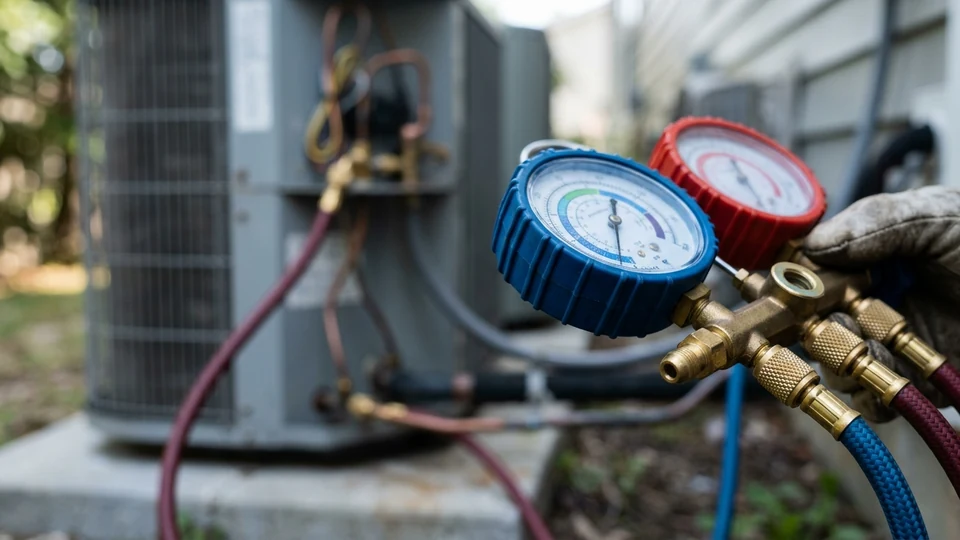
Mechanical gauge accuracy is expressed as a percentage of full scale, not of the reading. On a wide refrigerant scale this has a large practical consequence: the same gauge that is comfortably accurate at a high-side pressure can be almost unusable at a low-side pressure. The arithmetic is worth putting in front of a distributor before they standardise on one dial for every job.
| Accuracy class | Tolerance on a 0-800 psi scale | At a 100 psi reading | At a 250 psi reading | At a 450 psi reading |
|---|---|---|---|---|
| 1.6 | ±12.8 psi | ±12.8% of reading | ±5.1% of reading | ±2.8% of reading |
| 2.5 | ±20 psi | ±20% of reading | ±8.0% of reading | ±4.4% of reading |
Translate that into the number the technician actually cares about by dividing the tolerance by the slope of the pressure-temperature curve at that point, which can be read straight off two adjacent rows of the PT chart. If the chart shows about 5 psi per K near the operating point, a ±20 psi tolerance is about ±4 K of saturation temperature - the same order of magnitude as the superheat target itself. Read the slope from the chart for the refrigerant and the pressure in question rather than assuming a fixed figure.
Three practical conclusions follow. Use a dedicated low-side or compound dial for suction work instead of reading a low value at the bottom of an 800 psi scale. Specify the tighter accuracy class where the reading feeds a superheat or subcooling decision. And treat the manifold set as a comparative instrument for troubleshooting, with charge and commissioning decisions confirmed by weighed charge, calibrated temperature measurement and the OEM procedure. The EN 837-1 standard explainer covers how accuracy classes are defined, and the pressure gauge range calculation guide covers matching span to the reading you need.
Safety references and limits of the pressure reading
A2L refrigerants are commonly described as lower-flammability refrigerants. That classification does not remove the need for ventilation, leak control, trained service work, approved tools and the equipment maker’s service guide. AHRI’s Safe Refrigerant Transition resources and ASHRAE refrigeration standards are useful references for the broader safety context, while the equipment manufacturer remains the first source for service steps.
A reliable specification is based on exact service conditions rather than universal claims. The buyer verifies pressure range, scale units, hose compatibility, 7/16 inch UNF connection, leak-tightness, material compatibility, service temperature, packaging and documentation for the target refrigerant service. If a claim is not listed in Manogauge product data, Manogauge can review it before purchase.
For broader safety context, review AHRI Safe Refrigerant Transition and ASHRAE refrigeration standards resources.
Distributor and service-team buying checklist
A practical A2L refrigerant gauge order starts with service details. Which refrigerants will the team service: R-454B, R-32 or another approved refrigerant? Is the buyer ordering a complete manifold set, replacement gauge head or private-label dial? Does the technician need psi/bar dual scale, a 50 mm or 80 mm dial, radial or axial connection, and packaging for distributor resale?
For export and OEM buyers, Manogauge can review gauge range, connection, dial artwork and packaging requirements from Zhejiang, China manufacturing. Final approval is based on the buyer’s equipment, refrigerant supplier service guide and local service rules. RFQ information usually includes the target refrigerant, manifold model, hose connection, pressure scale, dial language and sample requirement.
A2L R-454B refrigerant pressure gauge selection connects low-GWP refrigerant adoption with real HVAC pressure readings, PT-chart interpretation, manifold gauge usability and documented procurement requirements.
Key takeaways
- A2L refrigerants such as R-454B and R-32 make pressure checks more dependent on equipment labels, PT charts, temperature readings and documented service procedures.
- R-454B is a zeotropic blend: calculate superheat from the dew point and subcooling from the bubble point, and take both from the refrigerant or OEM data rather than a printed scale ring.
- Mechanical accuracy is a percentage of full scale, so a 0-800 psi dial resolves the high side far better than the low side; specify a dedicated low-side or compound dial for suction work.
- ZX-10 refrigerant gauge orders include checks for the 0-800 psi range, 7/16 inch UNF connection, hose compatibility, dial scale and OEM packaging requirements.
- Pressure alone does not confirm charge; it is one field signal inside a procedure that also uses weighed charge, calibrated temperature measurement, leak checking and the equipment maker's instructions.
Related buyer pages
Refrigerant pressure gauge supplierRefrigerant-compatible Bourdon tube gauge options for HVAC/R buyers.
Related products
- Refrigerant Pressure Gauge - Radial (ZX-10-R) — 0–800 psi
- Liquid-Filled Pressure Gauge - Radial (ZX-06-R) — 0–60 MPa
Related reading
- Chiller Refrigerant Pressure Gauge Selection Guide
Select high- and low-side chiller refrigerant pressure gauges for R-134a, R-410A, R-407C and CO2 by range, materials and connections.
- 316L Stainless vs Brass Pressure Gauges: Corrosion Guide
316L vs brass pressure gauge wetted parts compared for corrosion risk in water, steam, ammonia, seawater, chlorides, CIP/SIP cleaning and diaphragm seals.
- Ammonia Refrigeration Pressure Gauge: R717 Materials and Safety
Ammonia refrigeration pressure gauge guide for R717 cold storage: suction, discharge, oil, defrost ranges, material compatibility and safety checks.
- Pressure Gauge Overpressure Protection Guide
Pressure gauge overpressure protection guide for pumps, water hammer, pulsation, snubbers, pressure limiters, safety cases and RFQ checks.
- Pressure Gauge Thread Size: G1/2 and 1/2 NPT Chart
Pressure gauge thread size guide: compare G1/2, 1/2 NPT, BSPT, BSPP and metric threads, including sealing, fit and RFQ checks.
Frequently asked questions
What is an A2L R-454B refrigerant pressure gauge used for?
It is used in an HVAC manifold set to read high-side and low-side pressure during service, recovery, evacuation checks and troubleshooting. The reading is interpreted with the equipment label, manufacturer PT chart, measured temperatures and approved service procedure.
Can pressure alone confirm the correct R-454B charge?
No. Pressure alone is not a complete charging method. For A2L refrigerants such as R-454B or R-32, technicians follow the equipment manufacturer procedure and compare pressure with temperature and PT chart data.
Where does a refrigerant manifold gauge connect?
A paired refrigerant manifold gauge connects to rated HVAC or refrigeration service ports using compatible hoses and valves. It is a temporary service tool, different from a single permanent gauge for water or coolant pipes.
What ZX-10 specifications are checked before ordering?
The order review covers the 0-800 psi pressure range, dial size, scale units, 7/16 inch UNF connection, hose compatibility, refrigerant service target, readability, packaging and OEM dial requirements.
Does one gauge configuration fit every A2L refrigerant service?
Universal compatibility is not automatic. Buyers request confirmation for the exact gauge configuration and target refrigerant service. Manogauge can review range, connection, dial and OEM requirements before quotation.
Does R-454B have temperature glide, and does it change how I read the gauge?
Yes. R-454B is a zeotropic blend, so at one pressure it has a bubble point and a dew point rather than a single saturation temperature. Superheat must be calculated from the dew point and subcooling from the bubble point; using the wrong one shifts the result by the whole glide. Take both values from the refrigerant supplier data or the equipment service manual for that refrigerant.
Can an R-410A manifold gauge set be used on R-454B?
The pressure range may look compatible, but that is not the whole question. The printed PT scale ring for another refrigerant does not apply, hoses, seals and the gauge set itself must be rated and approved by the tool manufacturer for A2L service, and the equipment manufacturer's service procedure governs the job. Confirm the tool maker's written A2L statement rather than inferring compatibility from the pressure range.
Why does a 0-800 psi refrigerant gauge feel imprecise on the low side?
Because mechanical accuracy classes are a percentage of full scale, not of the reading. A class 2.5 gauge on a 0-800 psi scale is accurate to about plus or minus 20 psi anywhere on the dial, which is 8% of a 250 psi reading but 20% of a 100 psi reading. For low-side work, use a dedicated low-range or compound dial, or a digital gauge, rather than the bottom of a wide high-pressure scale.